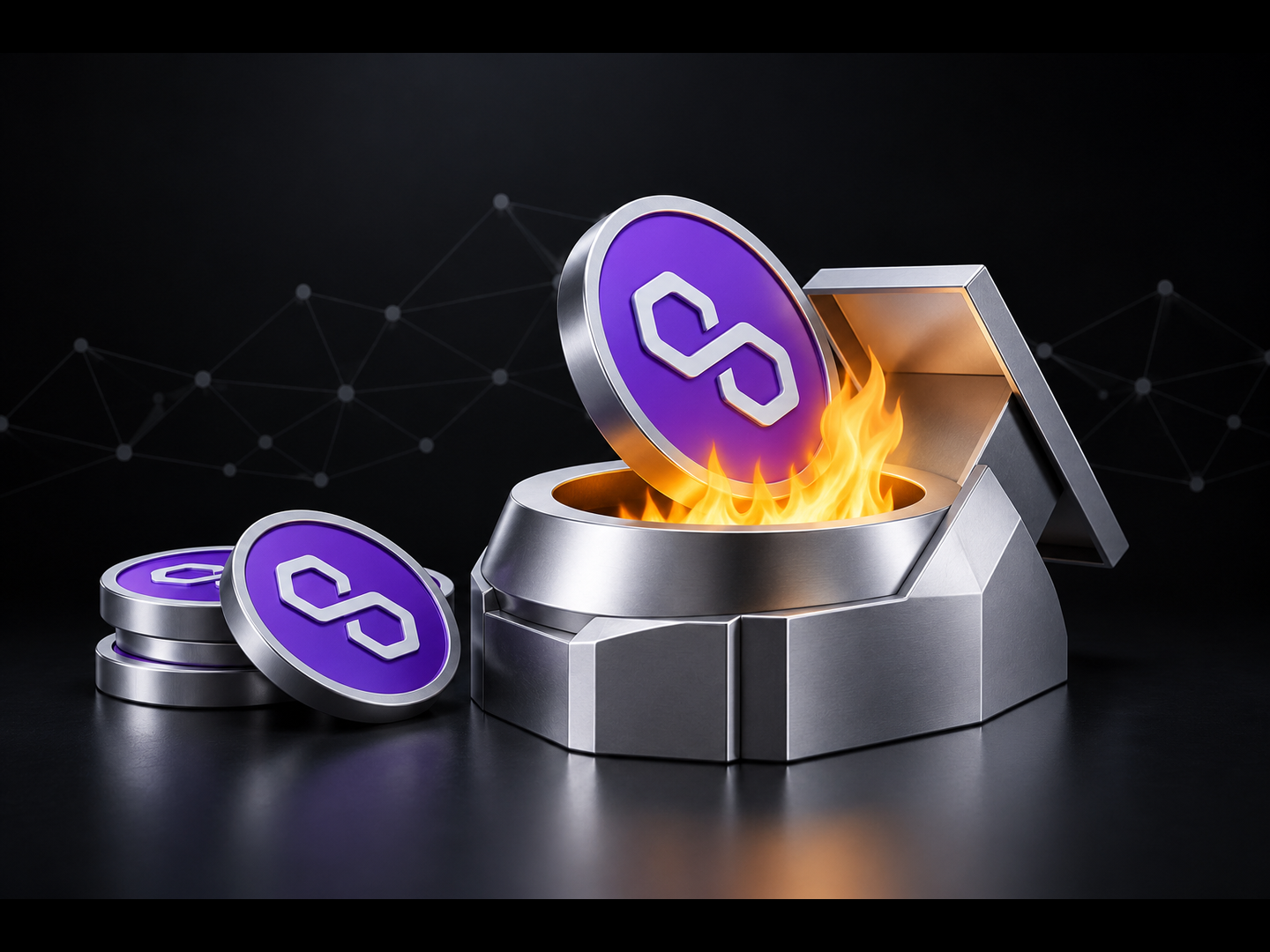
Will the Polygon POL token burn cap supply? Burning 100M tokens clears accumulated base fees, but ~2% annual emissions remain. Explore the full breakdown.
Polygon Foundation CEO Sandeep Nailwal confirmed on September 18–19, 2026 that the network has built a permissionless smart contract capable of permanently burning 100 million POL tokens in a single transaction. The contract is live on testnet. It has not yet reached mainnet, and as of the most recent reporting, no tokens have actually been destroyed. Once Polygon's Security Council delivers its final sign-off, anyone, not just the Foundation, will be able to trigger the burn.
That detail matters as much as the number itself. This Polygon POL token burn differs from earlier one-off burns in that the Foundation is deliberately handing the trigger to the public rather than keeping it in-house: after the first execution, the same permissionless logic lets any community member trigger further burns every quarter. The announcement, reported independently by KuCoin, ChainCatcher, CryptoBriefing, The Defiant and several other crypto-news outlets, arrives alongside a separate, less verifiable claim from Nailwal about Polygon's 2026 revenue standing relative to rivals Arbitrum and NEAR.
This article breaks down how the burn mechanism actually functions, what it does and doesn't change about POL's supply trajectory, and where the open questions sit.
How the Base-Fee Collector Accumulated 121 Million POL
Every transaction on Polygon's network pays a base fee, an amount set algorithmically by network conditions rather than by any single party. Polygon's own documentation specifies that this base fee is burned rather than paid to validators. Mechanically, that burning happens in two steps: each fee first flows into a collector contract, and only then is it permanently destroyed. Over time, transaction activity has built up a balance in that collector contract that Nailwal put at roughly 121 million POL.
The new contract targets that accumulated balance directly. Burning 100 million POL would remove about 83% of the collector's current holdings, leaving close to 21 million POL inside it before additional base fees start accruing again. In practical terms, Polygon isn't inventing a new supply of tokens to destroy. It's clearing out a backlog that has been building through ordinary network usage since the base-fee mechanism took effect.
Why the Contract Sits on Testnet Instead of Mainnet
Nailwal's own framing is unambiguous about sequencing: the burn contract is deployed and functioning on testnet, and mainnet deployment is contingent on the Security Council completing its final signatures. Polygon's Security Council is the multisignature body responsible for approving critical protocol-level changes before they go live on the production network, a standard safeguard for any contract with irreversible effects.
That distinction separates an announcement from an executed event. As of the reporting reviewed for this article, published within days of Nailwal's statement, the 100 million POL burn had not occurred. Readers encountering headlines about the burn should treat the current status as pending mainnet deployment, not as a completed supply reduction. Until Security Council approval clears, the Polygon POL token burn remains an announced plan rather than a finished transaction, and the first call of the contract will execute the full 100 million POL destruction in one transaction once it does.
The Burn Removes Less Than 1% of POL's Total Supply
The mechanism is one part of the story. Scale is the other, and it's easy to overstate.
| Metric | Figure | Context |
| Tokens to be burned | 100 million POL | One-time initial burn |
| Base-fee collector balance (pre-burn) | ~121 million POL | Per Nailwal, September 2026 |
| Collector balance remaining (post-burn) | ~21 million POL | Before new fees accrue |
| Burn as % of POL's original supply | ~1.0% | Against the initial 10 billion POL supply |
| Burn as % of current total supply | ~0.93% | Against ~10.716 billion POL, per Blockscout |
| Ongoing annual emission rate | ~2% | In effect since June 2025 |
A Polygon POL token burn equal to roughly 0.93% of total supply is a real, permanent reduction in token count. It is not, on its own, a mechanism that shrinks POL's overall circulating supply, because Polygon continues issuing new POL through scheduled emissions at an annualized rate of about 2% since June 2025. Whether POL's supply contracts or expands over any given period depends on how those two forces net out: cumulative fee-driven burns (this one, plus whatever quarterly burns follow) against ongoing issuance. Nailwal has said POL has been in a deflationary phase since January 2026, attributing that to base-fee burning outpacing emissions during that window, but that is a claim about a specific recent period, not a structural guarantee going forward. Network throughput, which Nailwal said has scaled to roughly 5,000 transactions per second, is the variable most likely to determine whether burns continue outweighing issuance, since more transaction volume means more base fees flowing into the collector for future quarterly burns to draw on.
Nailwal's Revenue Comparison Rests on an Unaudited Source
Alongside the burn news, Nailwal published a comparison of 2026 year-to-date revenue: Polygon at $24.5 million, against $8.41 million for Arbitrum and $5.6 million for NEAR. The Defiant reported that Nailwal attributed the comparison to "my analyst at ChatGPT," without publishing an underlying dataset or a stated methodology for how each chain's revenue was calculated or what activity was included.
That framing matters for how the figure should be read. A revenue claim traced to an AI assistant rather than an audited financial statement, an on-chain analytics platform's documented methodology, or a third-party research desk is not independently verifiable from the announcement alone. It doesn't make the underlying number false. Separate reporting cited by KuCoin, drawing on CryptoBriefing's earlier coverage, had already put Polygon's year-to-date fee revenue at a broadly similar $24.7 million figure earlier in September, alongside daily transaction counts in the 5 million to 6 million range, which lends the general direction some outside support. But a rough directional match from one earlier report is different from confirming the specific comparative figures against Arbitrum and NEAR, particularly since Nailwal's own Arbitrum calculation reportedly folded in Robinhood's chain and his NEAR figure included NEAR Intents, choices that shift what's actually being compared.
Risks, Headwinds & Identified Problems With the Burn Narrative
Several factors complicate a straightforward "less supply, higher value" reading of this announcement.
Execution is not guaranteed on any fixed timeline. The contract still needs Security Council sign-off before it can move to mainnet. Multisignature approval processes at protocol-critical layers don't run on fixed public calendars, so the gap between announcement and actual token destruction is an open variable, not a formality.
The burn's arithmetic effect on supply is small. At under 1% of total supply, the immediate mechanical impact on POL's circulating count is modest next to the scale of daily trading volume and emissions. ChainCatcher's coverage laid out the same math: the burn represents about 1% of POL's original 10 billion supply, or roughly 0.93% of the current total. Some market commentary published in the days after the announcement, including analysis from crypto exchange desks, characterized the burn as more symbolic than materially deflationary given that proportion, framing it as a narrative event rather than a structural repricing catalyst. That is one interpretation among several rather than a settled conclusion.
No hard supply cap exists. POL's ~2% annual emission schedule continues regardless of burn activity. Sustained net supply reduction requires quarterly burns to consistently outpace new issuance, which in turn depends on transaction volume and fee levels holding up or growing. A slowdown in network activity would narrow or reverse that balance.
The revenue claim underpinning the deflationary narrative lacks an audited methodology. As detailed above, the Arbitrum/NEAR comparison rests on an AI-assisted internal calculation rather than a disclosed, reproducible dataset.
Permissionless triggering cuts both ways. Removing the Foundation as the sole trigger for burns is a decentralization improvement in principle, since it means no single party controls timing. It also means execution now depends on public participation. If no community member calls the quarterly burn function, accumulated collector balances simply sit unburned until someone does, introducing a dependency the earlier, foundation-run model didn't have.
What Happens Between Now and the First Executed Burn
The near-term sequence is straightforward to track. Security Council members need to complete their signatures before the contract can deploy to mainnet; Polygon has not published a specific date for that step as of this writing. Once deployment clears, the first 100 million POL burn can be triggered by any wallet, executing the full amount in a single call against the collector contract. From that point forward, the permissionless design allows any community member to trigger subsequent burns once per calendar quarter, drawing on whatever base fees have newly accumulated in the collector since the last burn.
Readers tracking POL's supply dynamics going forward have a narrower, more useful question to watch than the headline burn figure alone: whether the pace of quarterly fee-driven burns, which scales with network transaction volume, consistently exceeds the roughly 2% annual emission rate. That comparison, not the one-time 100 million token event, is what will determine whether Polygon's Polygon POL token burn mechanism produces lasting supply contraction or simply offsets a portion of ongoing issuance.
Frequently Asked Questions
Has Polygon actually burned 100 million POL tokens yet?
No. As of the most recent reporting reviewed, the burn contract was live on testnet but had not been deployed to mainnet, and no tokens had been destroyed. Deployment is pending final sign-off from Polygon's Security Council, and the burn can only execute after that approval clears.
What is a token burn, and how does Polygon's base-fee collector work?
A token burn permanently removes tokens from circulation, typically by sending them to a contract or address from which they cannot be retrieved or spent. On Polygon, every network transaction pays a base fee that is first routed into a collector contract and then burned; the 100 million POL burn targets the balance that has built up in that collector over time.
Does this burn mean POL now has a fixed maximum supply?
No. The burn is a one-time (then quarterly) reduction of accumulated fee balances, not a change to POL's issuance schedule. POL continues to mint new tokens at an annualized rate of about 2%, a rate in effect since June 2025, so the burn does not by itself create a hard supply cap.
Who will be able to trigger future POL burns after the first one?
Any member of the community, not exclusively the Polygon Foundation. Nailwal has said that once the initial 100 million POL burn executes, the same permissionless contract logic allows anyone to trigger subsequent burns from the collector on a quarterly basis.
How reliable is Nailwal's claim that Polygon's 2026 revenue beat Arbitrum and NEAR?
It is a claim from Polygon's own CEO rather than independently audited data. The Defiant reported that Nailwal attributed the $24.5 million comparison figure to "my analyst at ChatGPT" without publishing a dataset or methodology, meaning the specific comparative numbers against Arbitrum ($8.41 million) and NEAR ($5.6 million) have not been independently verified.