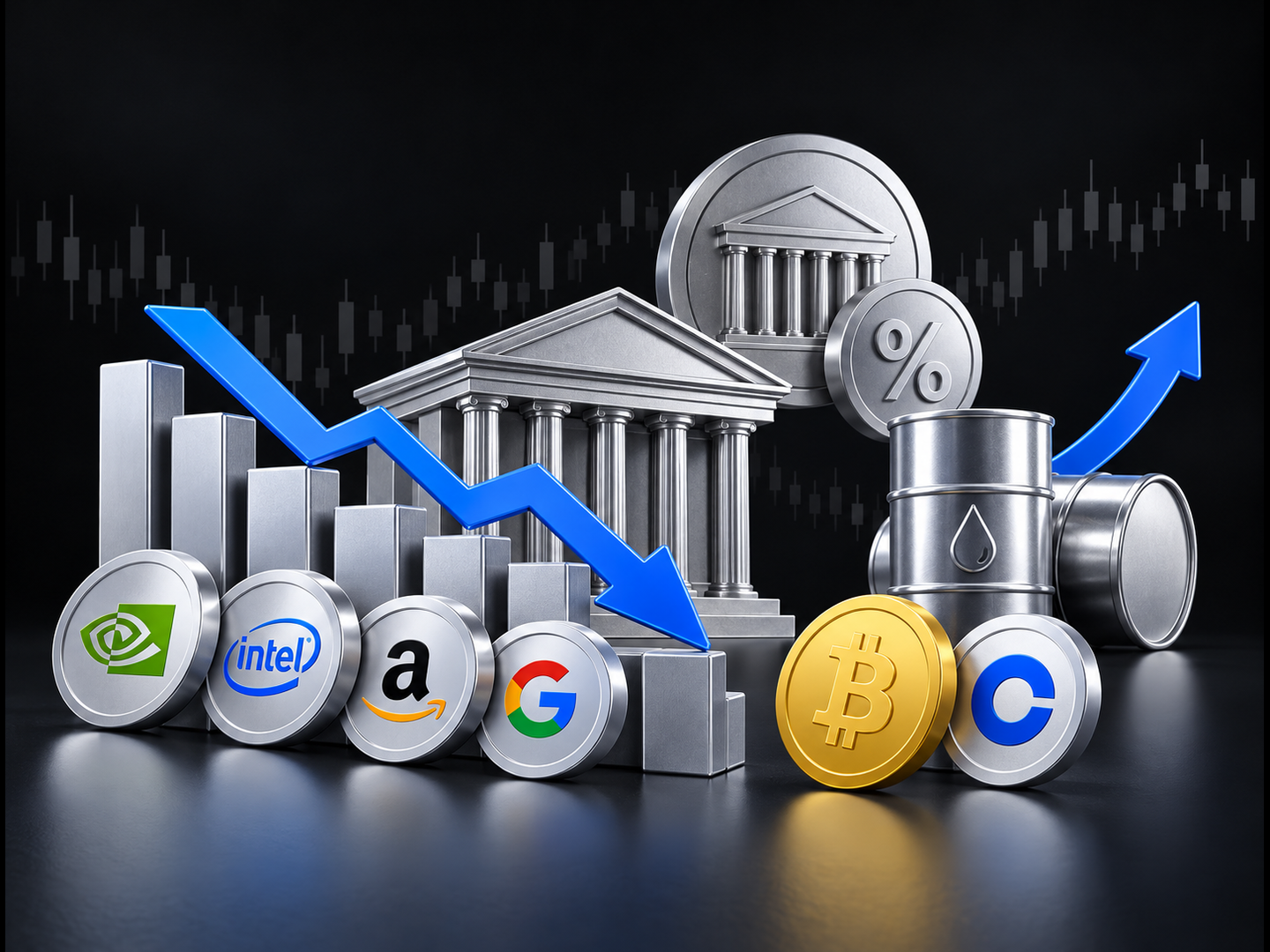
Wall Street's worst week since June sees nasdaq drops driven by ai debt fears, $110 oil, and rate-hike bets. Analyze the AI stocks sell-off and crypto correlation.
Wall Street endured its most punishing weekly performance in months, as a perfect storm of macroeconomic headwinds and sector-specific vulnerabilities converged to drive a broad-based risk-off environment. According to Associated Press closing data for Friday, October 16, the major indices posted significant losses, marking a decisive shift in market sentiment. For investors asking why the stock market is down, the answer lies in a trifecta of mounting pressures: escalating AI debt fears, a dramatic surge in global oil prices toward the $110 mark, and a sharp repricing of Federal Reserve rate-hike expectations.
The Headline Numbers: A Broad-Based Tech Retreat
The weekly toll on equities was substantial, completely erasing the gains achieved during the prior week. The S&P 500 fell approximately 2% for the week, closing down 1.1% on Friday, October 16, at 7,659.44. The Dow Jones Industrial Average proved slightly more resilient but still finished the week down 0.3% at 52,002.41. The technology-heavy Nasdaq Composite bore the brunt of the selling pressure, closing Friday down 2.1% at 26,140.03.
| Index | Friday, Oct 16 Close | Weekly Change | Context |
| S&P 500 | 7,659.44 | -1.1% (Daily) / ~-2.0% (Weekly) | Erased the prior week’s gains. |
| Nasdaq Composite | 26,140.03 | -2.1% (Daily) | First weekly loss in five weeks; worst since June. |
| Dow Jones | 52,002.41 | -0.3% (Daily) | Relatively resilient, but still negative for the week. |
Semiconductor stocks led the decline, reflecting growing concerns over capital expenditure sustainability and valuation multiples. AMD fell 6.0%, Intel dropped 5.8%, Micron declined 5.6%, and Broadcom shed 4.5%. Mega-cap software and internet giants were not spared, with Meta falling 3.7%, Alphabet down 2.5%, and Netflix dropping 2.9% following reports of a chief content officer change and plans to cut approximately 6% of its staff.
The AI Debt Angle: CoreWeave and the Broader Sell-Off
A primary catalyst for the ai stocks sell-off was a sudden, severe reassessment of the financial health of AI infrastructure providers. According to data from Roic, coreweave stock experienced a dramatic rout, falling approximately 15% on October 14 and another 8.3% to $60.36 on October 15, marking its lowest level since May 2025. The credit markets are flashing warning signs regarding the company's leverage. Roic noted that some of CoreWeave’s bonds were yielding above 15%, and Credit Default Swap (CDS) spreads surged past 1,000 basis points, up sharply from just over 600 basis points recently. The company’s balance sheet shows approximately $35.1 billion in debt against $5.524 billion in cash. In response to the market turmoil, CoreWeave’s CEO dismissed the selloff as “irrational,” pointing to a massive $104 billion backlog as evidence of robust future demand. However, the contagion spread quickly, with related AI infrastructure and cloud players like Nebius and IREN each falling more than 10%, signaling that AI debt fears are now a systemic concern for the broader tech complex.
The Macro Headwinds: $110 Oil and Sticky Rates
While tech stumbled, the energy sector provided a stark contrast, acting as a hedge against the deteriorating geopolitical and inflationary landscape. Chevron rose 2.6% and ExxonMobil gained 2.5%. The catalyst was a sharp spike in crude oil prices. Brent crude rose 3.7% to $109.86 per barrel. To put this in perspective, Brent was trading at approximately $72 in late February before the escalation of the Iran war. Consequently, the national average for U.S. gasoline climbed to $4.33 per gallon, according to AAA data. This energy surge directly feeds back into inflation metrics, complicating the Federal Reserve’s policy path. On the rates front, the 10-year Treasury yield eased slightly to 5.09% on Friday, though it had topped 5.30% earlier in the month. More importantly for market pricing, CME FedWatch data showed that the odds of a Federal Reserve rate hike in December surged to 74.3%, a dramatic increase from 50.2% just one month earlier. This repricing reflects the market’s growing conviction that persistent inflation (driven by energy and sticky services) will force the Fed to maintain, or even tighten, its restrictive stance.
Crypto Market Context: The Bitcoin-Nasdaq Correlation
The turbulence in traditional markets inevitably spilled over into digital assets, highlighting the persistent bitcoin nasdaq correlation. Despite the macroeconomic headwinds, Bitcoin initially demonstrated some decoupling resilience. According to Cointelegraph, BTC held steady near the $82,000 level on October 16, partially buoyed by comments from Federal Reserve Governor Waller, who gave no explicit hints regarding imminent rate moves. However, as the week progressed and the reality of the broader risk-off environment set in, Bitcoin’s momentum faded. By October 18, the price had drifted down to approximately $80,900, mirroring the cautious sentiment dominating the Nasdaq and broader risk-asset complex.
Conclusion: A Shift from Euphoria to Fundamental Scrutiny
Wall Street’s worst week since June serves as a stark reminder that market leadership can shift rapidly when macroeconomic realities collide with sector-specific vulnerabilities. The combination of ai debt fears, $110 oil, and elevated rate-hike probabilities has forced investors to transition from a mindset of growth-at-any-cost euphoria to rigorous fundamental scrutiny. As we look ahead, the market’s ability to stabilize will depend heavily on whether AI companies can justify their massive capital expenditures with tangible revenue, and whether the Federal Reserve can navigate the sticky inflation environment without triggering a deeper economic slowdown. Until then, elevated volatility across both equities and crypto markets is likely to persist.
Source Link:
Oil prices near $110 at close; WTI posts 10% weekly rise